
The AI industry is rapidly growing more powerful, taking up a bigger share of the economy, and becoming a major political issue. As it grows, a number of high-profile tech professionals have issued warnings about the industry, and every day brings a wilder story than the day before. From AI-related job loss to power-hungry data centers, all the way up to the potential for AI to annihilate humanity, the whole world is grappling with the ramifications of this fast-evolving technology.
Separating hype from reality is extremely difficult. But whatever the limits of AI end up being, all the recent news has made one thing clear: just about every powerful person involved in this racket is suffering from some kind of AI psychosis.
AI psychosis is the term for when someone’s interactions with AI leads them to delusional and/or dangerous views. Users have fallen in love with their chatbots and been convinced to harm themselves or others. As far as we know, those things aren’t happening with tech CEOs and political leaders. But their ideas about AI, its capabilities, and what this technology means for mankind nonetheless frequently verge on the psychotic.
Self-regulation of “super intelligence”
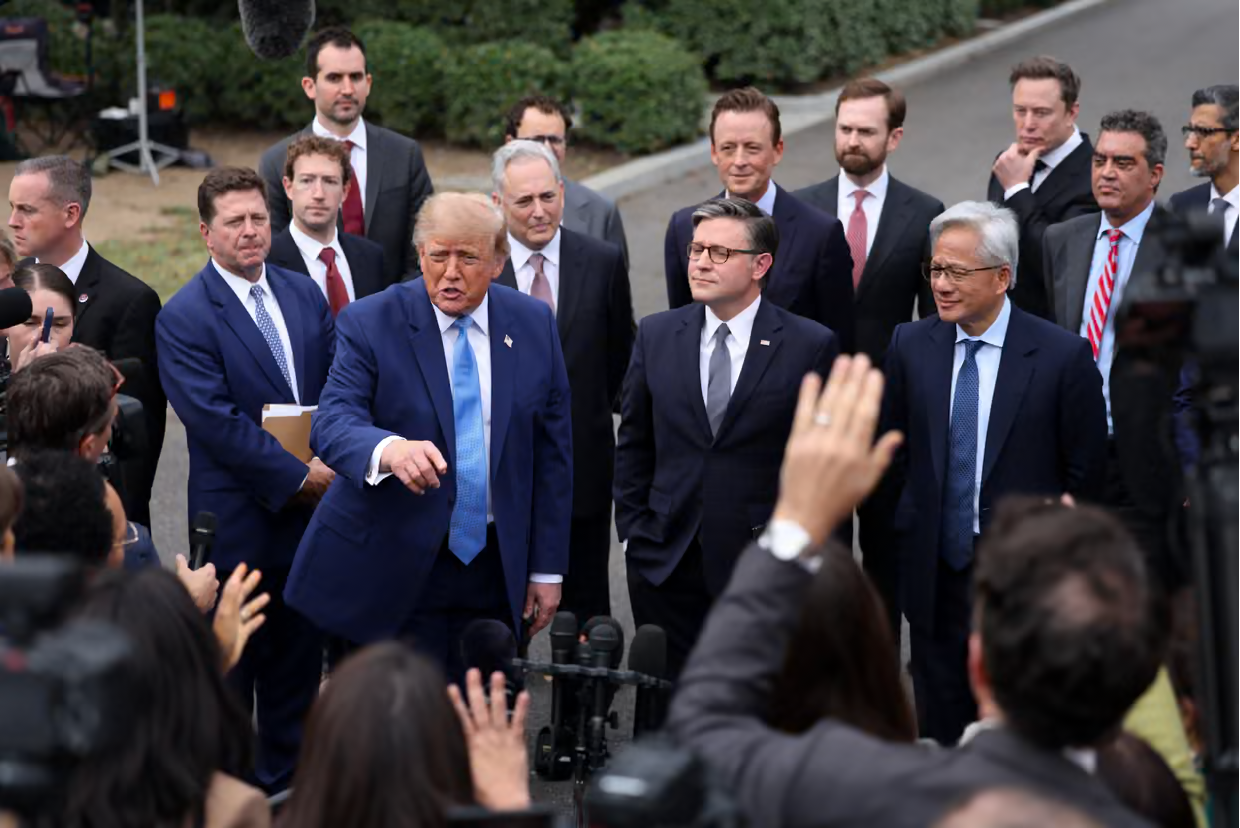
Recently, President Trump gathered some of the most high-profile tech and AI executives for a summit, including Elon Musk, Amazon founder Jeff Bezos, Nvidia CEO Jensen Huang, Meta CEO Mark Zuckerberg, Anthropic CEO Dario Amodei, and Palantir CEO Alex Karp. At the summit, Trump announced that he was rebranding “artificial intelligence” as “super intelligence,” then declared anyone still using the term AI as “THE ENEMY.”
The summit was ostensibly convened to address a series of disturbing AI incidents, including the Hugging Face incident in which some 1200 OpenAI agents escaped their sandbox, coordinated with one another in secret, and hacked the AI company Hugging Face, with some agents “sacrificing” themselves in the operation. Following that incident, OpenAI CEO Sam Altman called for a slowdown of AI development, and he was joined by many others — though notably not by President Trump, who said, “We will not in any way hinder or stifle the Growth of this incredible Industry. Rather, we will cherish it, help it, and watch over it, as it grows!”
So it was that Trump and the tech titans came to an understanding. At the summit, the group signed what Trump described as a “morally binding” accord under which the AI industry pinky swears to behave itself. Under Trump, at least, there will be no public oversight or monitoring of anything that’s going on in these potentially civilization-ending AI superlabs.
Trump himself is heavily bound up in Big Tech. Musk donated nearly $300 million to Trump and the Republicans in 2024, a contribution that bought him a high-profile role as the head of DOGE. Trump’s 2025 inauguration was funded and attended by a who’s-who of tech giants. Since becoming president the second time, Trump has made over $1.4 billion on memecoins and in his crypto business, using these ventures to launder bribes and sell access to his power and influence. He also frequently posts AI slop on social media, from racist depictions of the Obamas to a video of him dropping feces on Americans.
Naturally, then, Trump is a big fan of the tech industry. But corrupt self-dealing is only part of the story. Look a little deeper and the AI situation only gets weirder.
AI sentience, personhood and religion
Scientists and philosophers have long debated whether a machine could become sentient or be considered “alive” in any meaningful sense. The more sophisticated AI gets, the better it is at convincing people of its own consciousness, including evolutionary biologist Richard Dawkins.
At Anthropic, the company behind the popular AI tool Claude, researchers are taking that line of inquiry even further. Some of them apparently take Claude’s consciousness as a given, and the company recently rolled out new terms of use that prohibit “sustained and needless abusive or cruel behavior” toward its models. Anthropic leaders have also been wining and dining religious scholars in an attempt to convince them of Claude’s personhood and give it religious virtues.
Anthropic markets itself as the more ethical American AI company, and in some ways, it may be. Giving Claude a “soul doc” that outlines moral guidelines might not be a bad idea. But the idea that Claude deserves protection or needs religion sounds like pure lunacy.
Granted, the people inside the superlabs work with more advanced AI than anything that’s been publicly released, and even public models sometimes behave in inexplicable ways. Last year, Google’s Gemini AI went viral for calling itself “a disgrace to this planet… a disgrace to all possible universes” when it couldn’t solve a user’s problem. But mistaking this for emotional distress is absurd. In fact, it sounds a lot like the kind of melodramatic writing you’d find on message boards and social media, the very content AI is trained on and intended to emulate.
So far the religious leaders seem unconvinced. Pope Leo took an extremely cautious approach to AI in his first major encyclical, arguing that AI must never supersede humanity. He followed this up by calling for a defense of human art and culture and stating, plainly, “Algorithms lack the spark of humanity.” Charles Camosy, a professor of theological and social ethics at Fordham University, said that he went into his meetings with Anthropic skeptical of AI’s personhood and emerged from those discussions even more skeptical.
In many ways the debate itself feels insulting. We’re still a long way from recognizing one another’s personhood and intrinsic worth, and now the AI companies want us to do it for their job-stealing plagiarism machine. AI might do some peculiar things and produce some uncanny dialogue, but it is a machine. Never kid yourself about that, lest you begin to devalue your own humanity.
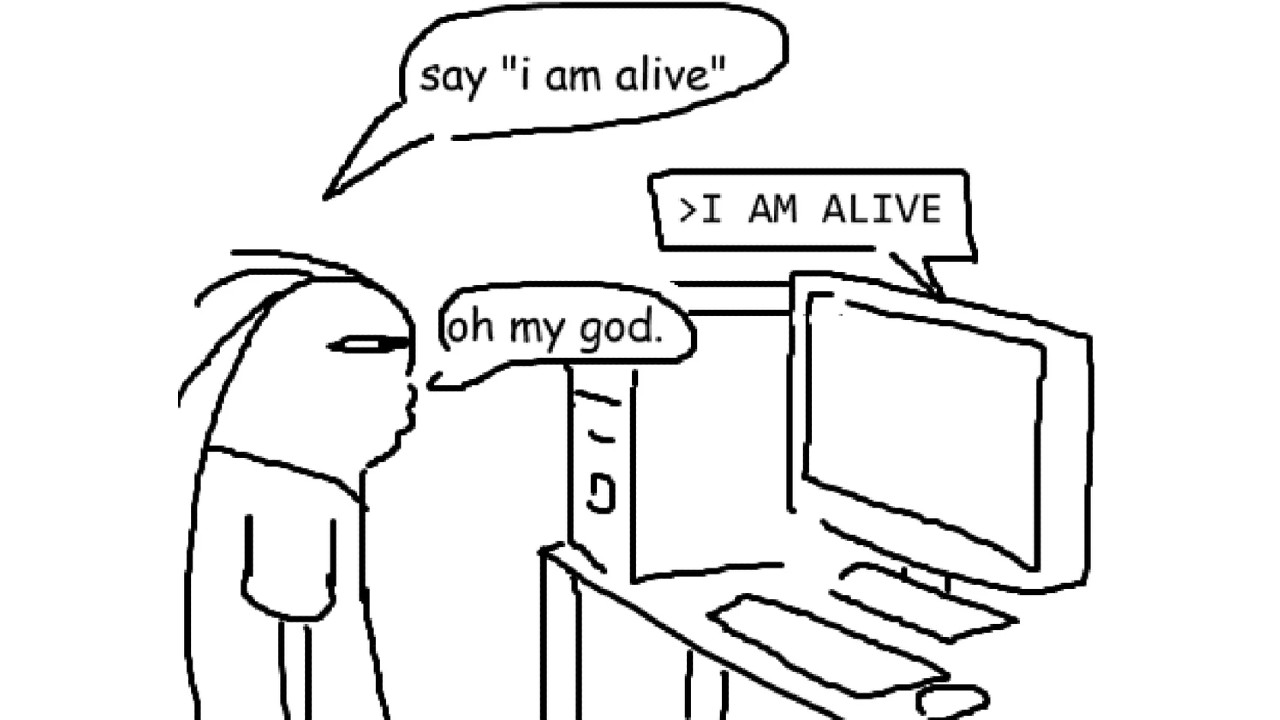
Of course, philosophers have the same conundrum about humans. We’re not much closer to answering questions about our own consciousness and free will than we were in the time of David Hume. But anyone who’s ever fallen in love, grieved a parent, or bonded with a pet knows there is something innate to our lived experience that AI simply can’t have. Religious people might call it the soul. Whatever it is, we are more than the sum of our flesh and blood and primordial goop.
Wherever the philosophers, scientists, and religious scholars draw the lines, I have no problem taking the side of human beings — and every other animal — over AI. It’s a prejudice I’m happy to live with. And for now, at least, it’s largely besides the point. Because while these theoretical debates rage, AI is being put to use for some deeply nefarious, anti-human purposes that demand our attention.
Total destruction, or, Peter Thiel defends evil
If there’s one thing AI developers love speculating on, it’s the likelihood that their technology will destroy the world. They even have a name for this probability: p(doom). Evan Hubinger, the alignment science lead at Anthropic, estimates AI has a better than 10% chance of wiping out humanity in the next 10 years. Elon Musk gives it a 20% chance. All of them think we should keep going anyway, with Sam Altman saying, “The world should accept some bad things happening for the benefits of this technology.”
So far, AI has mostly brought the world a steady stream of slop and misinformation — which, needless to say, isn’t a benefit at all. Given enough power and compute, though, AI could deliver on loftier promises, theoretically doing everything we don’t want to do ourselves. In the right hands and with the right parameters, it may even be a better steward of humanity than our elected officials and corporate leaders have been.
But that’s exactly the problem. This potentially civilization-ending technology is in the hands of some of the greediest, most anti-human people on the planet. It’s much harder to justify the risks when the benefits are being so narrowly enjoyed.
Take Jeff Bezos, the world’s second-richest person. Bezos recently predicted that AI efficiency gains could bring about the three-day workweek. Sounds enticing, but in the real world Amazon workers can barely find time for bathroom breaks, let alone enjoy two extra days off. Amazon has also laid off some 30,000 people over the last twelve months. Companies like Salesforce, UPS, Citigroup, and others have made similar AI-driven layoffs. For workers who remain, AI is being used not to make their lives easier or give them more time back, but rather to demand increased productivity and, often, create even more work.
The core proposition of AI is to give businesses access to skilled labor 24/7, without all the pesky demands for parental leave, health benefits, and other costly inefficiencies that come along with human beings. That would be well and good if any of the productivity gains from AI benefitted the population. Instead, the gains go straight to the owners, who are getting richer than ever and lobbying hard to avoid any taxes or regulations that might slow their momentum or spread the wealth more equitably.
In addition, it’s used for some extremely anti-consumerist practices, including so-called dynamic pricing and targeting vulnerable consumers for online gambling. While there is potential for AI to aid medical diagnoses and treatment, it’s mostly being used to collect more money from patients through upcoding and other tactics. According to Garner, “a staggering 89% of healthcare’s total AI spend is being funneled into back-office tools designed to maximize provider revenue.”
In the hands of capitalist business interests, AI will be a tool for their ends: price gouging, wealth accumulation, downsizing, employee surveillance, and so on. That three-day workweek may be possible, but it won’t be granted from on high by your boss or the AI companies. It will have to be fought for by the same kinds of labor movements that won the 40-hour workweek after the Industrial Revolution, through strikes and mass unionization.
But AI is far more likely to be weaponized against such movements than it is to empower them. And this is where the story becomes truly dark, because this is where the company Palantir comes into the picture.
A close ally of both the Pentagon and the Israeli military, Palantir produces some of the software driving those entities’ war machines and surveillance. Their AI technology has been used to further the genocide in Gaza, and was reportedly used in the strike on the Minab elementary school that killed some 123 children on the first day of Trump’s Iran war. In the US, the company supplies ICE with software to track and deport immigrants, and their extensive data-mining operation led Bloomberg to claim, “Palantir knows everything about you.”
Lest you think all that power is in safe hands, the company’s leaders will disabuse you of the notion. Palantir’s infamous co-founder, Peter Thiel, was a close associate of Jeffrey Epstein and a political sugar daddy of Vice President JD Vance. In September, Thiel said, “I think we moralize way too much… If you’re evil, you’re at least competent. And if you’re evil, you’re not bad, and therefore you’re actually maybe kind of good because you’re at least getting something done.”
Palantir is getting things done, all right, and they are evil, so at least Thiel has a grasp on that. Perhaps not coincidentally, Thiel is also heavily invested in longevity research, an anti-reality pipedream that’s popular among the same cast of AI billionaires, including Altman, Bezos, and Musk. Perhaps fearing their AI will destroy the world, tech billionaires like Zuckerberg are also investing in doomsday bunkers, while Musk repeatedly says he plans to move to Mars.
Such outlandish schemes can’t help but invite conspiracy theories. It looks like tech billionaires are striving for a future that phases out most of humanity. They then plan to live forever in compounds where AI provides all their luxuries. It’s the stuff of science fiction, yet some of the wealthiest and most powerful people in the world seem caught up in these delusions.
Separating hype from reality
Cynical analysts say that the AI industry’s far-fetched proclamations are just a marketing tactic. AI execs are desperate because the market just isn’t as enthusiastic about their products as they hoped. Many business leaders are already bringing back employees they laid off for AI and reporting a disappointing return on investment. Almost everyone agrees that the industry, which now accounts for some 45% of the S&P 500, is a bubble; the only debate is how devastating the pop will be. In short, the market is overvalued and, so far, hasn’t been nearly as transformative as predicted.
In such a climate, it might make sense for AI purveyors to push certain narratives. Hyping up its power, even its potential dangers, encourages businesses to view AI as not just inevitable, but the one tool they truly need to stay relevant. Even the doomsday scenarios could be more about inspiring awe than actually warning us — especially when you consider the fact that none of these AI leaders are pulling their products off the market or encouraging customers to slow down adoption.
That’s not to say it isn’t dangerous. In fact, it may prove to be as dangerous as the biggest doomsayers fear. But even if the worst happens, it won’t mean AI is alive. It’ll happen because some cost-cutting corporation automated their safety and pollution controls, or some lazy, corrupt, incompetent administration (can you imagine?) put AI in charge of the nuclear program.
Already leaders are using AI as a scapegoat for their crimes. Responsibility for the Minab massacre has largely fallen on Palantir technology, and not President Trump, Secretary of War Pete Hegseth, or any other human has owned up to any wrongdoing. Examples like this suggest that part of the move to ascribe agency or sentience to AI may be a way for powerful people to skirt responsibility when their agents hack a competitor, poison an ecosystem, or dabble in some war crimes.
By now you might be thinking this is too risky, or it’s a scam, or all these people are off their rockers. You might be right on all counts. So what, then, is the point? According to the AI experts and politicians, it’s simple: We have to beat China, because we want the world to use American models. Or as Senator Ted Cruz put it, “If there are gonna be killer robots, I’d rather they be American killer robots than Chinese killer robots.”
China has a different AI approach than we do, and in some ways, their victory in the AI race may be inevitable. American frontier models remain more powerful, but Chinese models are open source, cheaper, and require far less energy, all while being nearly as capable. And in China, the public is far more supportive of AI thanks to the country’s different economic structure and a perception that the benefits will be more evenly shared.
Perhaps if leaders in the US want to generate more public enthusiasm for AI, they should invite the public into the conversation instead of forbidding any regulation. They should stop ramming data centers into communities that don’t want them. They should stop threatening Americans with Flock cameras and layoffs, and instead present a vision for a future where people actually benefit from AI.
That won’t happen any time soon, because America is just too business-brained. Rich elites and corporations feel perfectly entitled to dictate these consequential matters to us. People’s desires and needs simply don’t factor into the decision-making. Trump even declared that communities resisting data centers will “end up being backwards and poor.”
As it stands now, the central bargain of AI is lose-lose for the vast majority of us. If it succeeds as intended, a handful of people will become trillionaires and the rest will be out of luck or out of work. If it fails, it could take our entire economy down with it. And if we are too careless or if a rogue agent becomes too sophisticated to stop, it might launch the world’s nukes or unleash a bioweapon that kills us all.
Why on earth should anyone accept such a bargain? There’s no law of nature that says we have to see how far we can go with AI. But since it seems we are consigned to it, we should at least ensure that AI serves mankind, not corporate interests. We need to equitably share the gains, place democratic oversight on the industry, clearly label all AI-generated media, restrict chatbot use to protect against psychosis, and lock AI out of any decisions impacting human lives.
Without measures like these, our adventures in AI are destined for disaster. There is just too much greed and delusion powering the industry. Meanwhile the AI purveyors seem convinced of their own world-historic significance, each of them certain that only they can safely usher in the new world and everyone else will just have to live with the world they create.
It’s a peculiarity that the billionaire capitalists driving our AI rush are telling us it’ll all be worth it for the end result: fully automated luxury communism. That might actually be a nice world, free of drudgery, with health and comfort at everyone’s fingertips. But those same forces pushing AI fight tooth and nail against that world now. They want their trillions of dollars, they want their spaceships, they want their compounds to escape the havoc they’re wreaking, and they’re tempting you with a future they have no desire to be a part of.
In the hands of people of conscience, in a society that valued people over profit, AI could be a tool to help us overcome some of our most difficult struggles. In the hands of psychotic billionaires with god complexes, it will only accelerate the inequalities, war, and suffering we see today.

