Democratic socialism is the compromise position

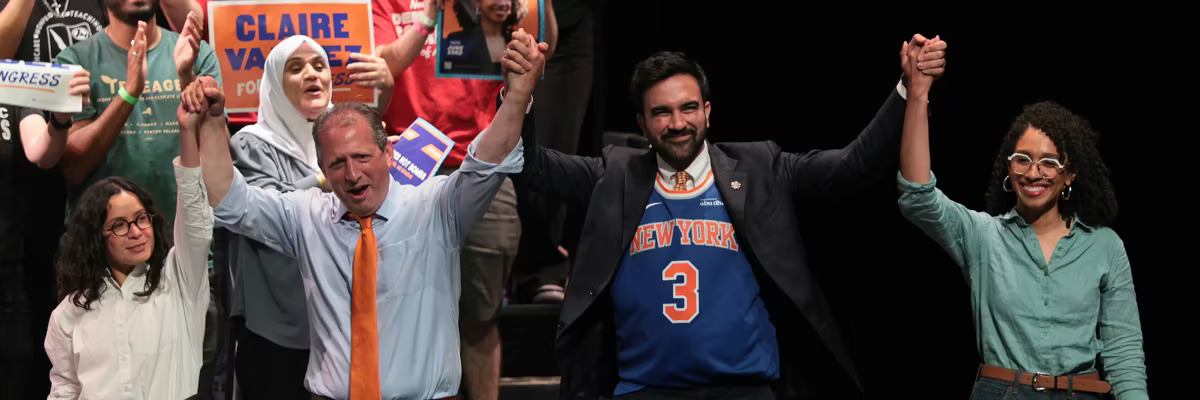
Congressional candidate Claire Valdez, Congressional candidate Brad Lander, Mayor Zohran Mamdani, and Congressional candidate Darializa Avila Chevalier raise their hands during a Get Out the Vote rally at King’s Theater on June 18, 2026, in New York City. (Photo by Michael M. Santiago/Getty Images)

Other than the continual circus in the White House, the most important political story in America may be the resurgence of democratic socialism. Ignited by the 2016 and 2020 presidential campaigns of Vermont Senator Bernie Sanders, the movement achieved its biggest victory last year when self-described democratic socialist Zohran Mamdani was elected mayor of New York City. Now, fueled by backlash to the extremist MAGA agenda and multiple ongoing crises, the Democratic Socialists of America (DSA) have claimed 38 electoral wins so far this year and 120,000 active members, making them the largest socialist organization in US history.

Naturally, this has the establishment’s hair on fire in both political parties. On the Democratic side, leadership oscillates between snubbing democratic socialists and disowning them outright, with Senator John Fetterman calling Mamdani’s rise a “gift to the Republicans” that makes Democrats look radical. Centrist-liberal magazine The Atlantic referred to DSA as “a parasite” that was “hijacking the Democratic Party.”

On the Republican side, the hysteria is even more severe. President Trump, who seems quite enamored of Mamdani on a personal level, called him a “100% communist lunatic.” Recently Trump has been trying to resurrect the Red Scare, labeling DSA candidates “hardcore, godless communists” and invoking communism some 94 times in just a few weeks. Trump’s Deputy Chief of Staff for Policy, Stephen Miller, connected leftist politicians, communism, and political terrorism into one vast conspiracy and declared it the “fatal cancer of civilization.”

Despite the delirium, many democratic socialist policies are popular, particularly those that expand public services and safety nets for healthcare and childcare. Such ideas only sound radical in a nation grown numb to the extremes of capitalism. But following decades of upward redistribution, worsening public services, deteriorating labor power, and all the other abuses of our current system, democratic socialism isn’t radical at all – it’s a compromise.

Continue reading
Internet privacy bill illustrates who Republicans really work for

GOP laughing

Paul Ryan shares a laugh with some fellow Republicans.

The Republican Party provides formal, governmental representation to corporate and big-money interests. While the Democratic Party is plagued by its corruption, and faces resistance from its left-wing base because of it, the Republican Party has corruption in its DNA. From top to bottom, the GOP is firmly, openly, and proudly committed to the interests of American oligarchy, starting with oligarch-in-chief Donald Trump.

At the bottom of the list you might find Louisiana Representative Clay Higgins. During his 2016 campaign, the brand-new congressman received a mere $300 from the telecommunications industry. This week, Higgins and 264 congressional Republicans scrapped regulations that prevented internet service providers from selling their customers’ web history. That $300 investment in Higgins – and much larger ones for his fellow Republicans – will pay off in the billions for corporations like Verizon, AT&T and Comcast. Continue reading

Election season highlights the shallowness of American democracy

Charles and David Koch are interviewed by MSNBC anchors "Morning" Joe Scarborough and Mika Brzezinski.

Charles and David Koch are interviewed by MSNBC anchors “Morning” Joe Scarborough and Mika Brzezinski.

No serious scholar of history or political science considers the United States a democracy. Nor is the country a Constitutional Republic, which is sometimes given as the technical term. We like to think of ourselves as democratic, but America is, more or less officially, an oligarchy. This means the people have very little influence over policy, which is instead implemented by and in favor of private concentrations of wealth.

With election season in full swing, this simple fact gets overlooked and the platitudes about democracy are pushed harder than ever by pundits and politicians. Ironically, no time in America reveals more about our democracy deficit than the presidential election cycle. Between campaigns that are bought wholesale by billionaires and a news media that frames the election in the perspective of big business, Americans really aren’t invited to participate in the process much at all. Continue reading