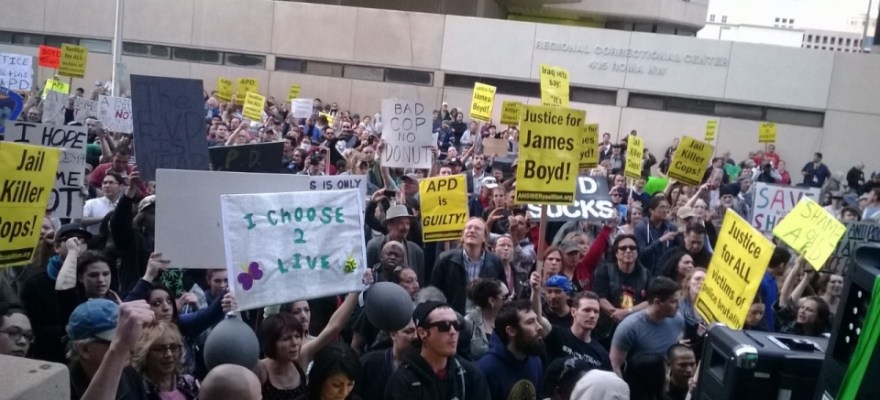
In Albuquerque, citizens seek protection from the protectors

If you move through city streets fearful of being assaulted, you better keep one eye on the police – especially if you live in Albuquerque.

Since 2010, police have killed 25 people in New Mexico’s largest city. For every 20 people murdered there, police kill an additional three. Put another way, in Albuquerque, you’re approximately 15 percent as likely to die at the hands of a police officer as you are a common thug or a spurned lover.

Hostility between the Albuquerque Police Department and the citizens has been boiling over for months, and it reached a peak following the release in March of a disturbing video that showed police killing an unarmed, mentally ill homeless man named James Boyd. Mounting protests in the wake of this spate of killings led to a tense confrontation between the city’s government and its population on May 5. Protestors commandeered a meeting at the Albuquerque city hall, calling for a citizen’s arrest of the chief of police and issuing demands.

Media coverage has been limited. Several outlets ran a tedious story with the headline, “What’s Next for Troubled Albuquerque Police?”, as though the real story is the APD’s struggle to move on from their public scrutiny and not the citizens’ outrage over the deaths of their friends and loved ones. “Angry protesters… shout[ed] at council members and caus[ed] such a ruckus that the panel’s president adjourned the meeting,” the story said. Notice that vivid descriptions of the activists’ misbehavior are plentiful, but for police, the language is more reserved and cautious, even as the story describes their lawless executions.

Worse still, the L.A. Times had this to say: “The council had tried to meet Monday, but adjourned early when rowdy protesters took over the meeting – sitting in council members’ chairs and even eating their Girl Scout cookies.” It’s stunning that a news outlet would even mention sitting in chairs and eating Girl Scout cookies when the discussion is supposed to be on deadly, excessive police force.

Albuquerque may be an extreme case of the law spiraling out of control, but it is far from unique. Heart-wrenching statistics about wrong-door raids and petty crimes being met with deadly violence tell a tale the media won’t touch: excessive police force is a systemic problem, not the result of a few bad eggs. It is routine; daily; even hourly. It runs the gamut from the absurd – a whole team of officers detained a female jogger for jaywalking in February – to the outright hideous, as in the cases of James Boyd, Robert Saylor and countless others.

A symbolic casket bearing the names of people killed by APD was carried to police headquarters. Photo by Luke Montavon, The Jackalope.

A symbolic casket bearing the names of people killed by APD was carried to police headquarters. Photo by Luke Montavon, The Jackalope.

Despite this, and even as more and more of the general population awakens to the reality of routine police cruelty, city officials, congressmen, judges and the U.S. President can say nothing critical of law enforcement without paying an enormous political cost. It’s somewhat mysterious why: on paper, there’s almost nothing in America failing as spectacularly as law enforcement.

Even as the crime rate declines, the use of paramilitary tactics by police escalates. No matter how badly they screw up, there are a plethora of defenses for police to choose from, including the standby, “It’s a dangerous job.” Statistically, being a police officer is far from the deadliest job in America, but a certain degree of risk is entailed. Yet it’s precisely for the assumption of that risk that police are held in such high esteem in the first place. By dressing police up like storm troopers and letting them shoot at anyone who might or might not be holding something that might be a weapon, we take nearly all their risk away and assume it ourselves.

As Radley Balko demonstrates in his crucial “Rise of the Warrior Cop,” both the Pentagon and private defense contractors capitalize on departments’ soaring federal funds, inundating them with unneeded weaponry. Thus, you get perverse statistics like this, from Balko’s book: in 2010 in Johnston, RI, population 28,769, the police department received $4.1 million in surplus military gear from the Pentagon, including 30 M-16s, nearly 10 million rounds of ammunition, a “sniper targeting calculator,” 44 bayonets, 12 Humvees and 23 snow blowers. With so many toys and so little crime, it’s no wonder that police use excessive force on every superficial offense, from low-level drug possessions to barbering without a license.

Protesters occupy APD headquarters in March to protest the death of James Boyd.

What’s happening in Albuquerque is truly inspiring. It deserves to be a much bigger news story than it is. As the indictments pour forth on the APD, including a Department of Justice report that documented a pattern of excessive force and poor training, citizens are taking action to ensure that police don’t weasel their way out of the criticism with a few meaningless press conferences and payouts. The city appears to be listening, with Mayor Richard Berry promising changes even before the DOJ issues its recommendations.

Police departments across the nation are rampant with guns and tanks and narrow on compassion and empathy. It’s time to overhaul their militarization and warrior mentality. Law enforcement should be an ally to the people, not the people’s most feared adversary. If change can happen in Albuquerque, it can happen anywhere – we just have to have the courage to demand it.

The Donald Sterling case highlights a shameful hypocrisy

No one can talk about LA Clippers owner Donald Sterling without getting a foul taste in their mouth. The man exudes all the qualities that have derailed civilized society; he is a bitter, bigoted billionaire who feels entitled to anything and everything.

It’s certainly one of the most bizarre cases of public foot-in-mouth that I know of. What it essentially boils down to is a rich, white man arguing with his half-black girlfriend – a transparent gold digger who pretends to wish she could agree with him – about her, in his view, improper decision to post pictures of herself commiserating with black men on social media. In the course of the argument, he outs himself as incredibly racist, saying such surreal things as, “You’re supposed to be a delicate, white girl,” and talking about all the generous gifts he showers his black athletes with.

The whole exchange is a fascinating lens into the wild world of America’s privileged. Imagine stepping behind the scenes of Rome around the time of its collapse, with all the decadence, debauchery and immorality that accompanies it. Sterling regards Stiviano as a status symbol, which is why he’s so offended that she posts pictures online that he thinks cast him in a bad light.

But there’s still something fishy about the reaction to his vile comments. Not in the disgust that just about everyone has expressed, which is understandable, but in the official reactions.

The NBA owners club is a private enterprise, with rules and stipulations that are privately administered. Sterling isn’t in any legal trouble. Yet many people are still worried about his being punished for something he said in private. If legal action were being brought, it’d be tantamount to convicting Sterling of thoughtcrime.

In most cases, I’d be inclined to agree. But Sterling’s case is exceptional. He’s one of the most open racists the media has had the chance to enjoy in recent years; perhaps only Michael Richards generated more heat in the last decade and I’d argue his comments – though far more violent – were actually more innocent, given circumstances and setting. It sends a chill down the spine to know that “owner” is the relationship Sterling has to his mostly-minority basketball team. Knowing what we now know about him, banning him from the NBA ought to be almost a given.

What makes the decision fishy, though, is the NBA’s suddenly giving a shit. As has been consistently pointed out, Sterling’s record of racism extends much further into his past than the incident with girlfriend V. Stiviano. It’s essentially a badly guarded NBA secret, and numerous news outlets have pointed out his official record of discriminating against minorities in his real estate enterprise. Yet now that it’s out in the open, his former friends – who surely knew all along – must vote to remove him from his position.

One must ask whether that’s truly an honorable thing. If these people had no problem with Sterling’s views and, more importantly, his actions when they were slightly less public, why do they have such an issue with them now? It’s damage control, plain and simple: it’s got nothing to do with correcting Sterling’s sins or the NBA ownership evolving on an important moral issue.

Sterling’s own candid comments reveal the staunch racism embedded in the culture of the white, wealthy, ownership class. The whole reason he launched his tirade against Stiviano at all is that his friends were taunting him for her posting pictures with various black athletes. Sterling’s friends said, in essence, “Ha, ha, Don, we saw your girlfriend with Magic Johnson. Do you think she’s fucking him? You know what they say about black penises!” Sterling takes this up with Stiviano, asking, “Why do you have to take pictures with those people and embarrass me like that?” Once those comments are made public, the same type of people harassing Sterling in the first place, leading him to his incoherent, outraged babbling, are now saying, “We are shocked and offended at Don’s comments and want him out of the NBA.” It’s the very definition of hypocrisy, and yet athletes and commentators alike are applauding it.

This is certainly not an attempt to cast Sterling as some kind of victim, as a handful of fringe commentators on the right have. He absolutely deserves all that is coming to him. This article isn’t to argue with that: it’s to say he probably deserves far more, and there are probably far more people out there who do, as well.

I am rarely impressed by the apologies of public figures, nor by reprimands that the wealthy institute among themselves. The league wants to fine Sterling a meager $2.5 million and force him to sell a team that’s worth many times more than that? The poor guy; that really ought to learn him.

America’s billionaires are impervious. Slapping them on the wrist for saying something naughty is totally ineffectual in terms of combating the systemic roots of their incredible, kingly privilege. Donald Sterling is little different from the oil executive who receives a huge severance for wiping out an ecosystem or the banker who gets a bailout when his predatory lending schemes lead to his bankruptcy.

Bundy ranch case about politics, not principle

Chances are you’ve heard, by now, of the great American frontiersman Cliven Bundy, whose decision to parade his inherited cattle on public land that belongs to the endangered desert tortoise has led to his being fined by the U.S. government. Bundy has refused to pay his fees and fines with armed resistance. As a result, there was a standoff in Nevada between the government, who attempted to remedy the debt by seizing Bundy’s cattle, and Bundy’s militiamen.

He definitely isn’t a hero, as some on the right have made him out to be; he’s merely an entitled curmudgeon who doesn’t like to pay bills. The only reason Bundy is a hero on the right is that his adversary is a federal entity, the Bureau of Land Management (BLM), operating under an Obama-controlled White House. The government has been attempting to collect fees from Bundy for 20 years – killing an endangered species is OK as long as you pay for it – but the situation has been in jeopardy of exploding in recent weeks.

Protesters gather at the Bureau of Land Management's base camp near Bunkerville, Nevada

Between fracking and widespread deforestation, the way private entities pillage public land for profit is a tragic disgrace. Bundy wants his freedom to participate, too, and conservatives have rallied in his defense.

As evidence that Bundy’s life as a cause célèbre for the right is based entirely on politics and not on principle, recent racist comments of Bundy’s have caused many of his supporters to walk back their endorsement. Whether he’s a racist or not has nothing to do with whether he’s right or wrong to use federal land in the way he has been – which is, apparently, freely and recklessly.

This is why, despite his multitudinous and colossal douche baggery, I find a very, very small measure of support for Bundy’s cause. His disregard of an endangered species is by far his biggest crime, but good luck selling the idea that a tortoise is more important than a hamburger. Nonetheless, there are questions about the way the government regulates both public and private land, and the Bundy case brings them to light.

Americans who choose to live their life in nontraditional ways face serious and disastrous consequences. Stories break fairly routinely about people in America being punished for living off the land or off the grid. Circumstances vary from story to story – one recent incident saw a renaissance woman being punished for using the sewer system for free – but taken as a whole, the stories paint a compelling portrait of an America that does not tolerate its citizens opting out of the established corrupt, corporate-driven society.

Bundy’s case is very sad for this reason as much as any other. By the right’s making a martyr of such an unsympathetic “victim,” there is a darker outlook on others who might, unlike Bundy, live outside business and the government’s jurisdiction in reasonable, eco-friendly ways. Under the draconian and radical-right direction of the present U.S. government, it isn’t difficult to imagine, for instance, a day when bicyclists will be fined for not pumping gas.

Bundy supporters confront the BLM agents.

Bundy supporters confront the BLM agents.

I also think it’s not so straightforward to criticize Bundy’s militia for showing up with guns. In a recent piece for Salon, Eric Stern writes, “Many repossession and foreclosure actions often involve a sheriff or other armed officials, and confiscation of property is an ordinary means by which a government resolves a debt.” Stern seems to wave his hand at this, saying it’s par for the course and therefore Bundy has no right to resist it.

Yet many folks, including many with the support of their communities and/or the Occupy movement, have protected their homes from bank foreclosures with a collective body mass. That, I think, is a tremendously wonderful and noble thing. Bundy’s wrongness doesn’t stem from his decision to meet an asset seizure with resistance – even armed resistance – but rather his dubious motivation, i.e., his desire to continue pillaging public land without consequence. That’s an important distinction, and to fail to make it is to leave others who resist asset seizure for better reasons open to the same criticism.

Bundy has not been done an injustice by the U.S. government. His reaction to this simple act of bureaucratic enforcement is dangerous and extreme. But the way the story is being presented is just as harmful because of the presupposed universality. It isn’t always wrong to resist asset seizure, nor is it always wrong to call bullshit on certain government fees. It just so happens that Bundy is wrong.

Bundy-ranch

My guess is that cooler heads will eventually prevail. Some lawyer or bureaucrat will talk Bundy down, the BLM will reduce or waive the fee with certain conditions, and the situation may be declared a victory for democracy and the Tea Party. That’s the only reason it might not work – the government-business complex is never too pleased with successful democratic coercion. But in many perverse ways, that is exactly what it will be.

If not, there’s no telling what could happen. It’s a hostile situation, and it’s made all the more combustible by the careless waving around of deadly weapons on both sides. Hopefully, the situation resolves itself peaceably. My only real wish is that this energy could be harnessed for something more productive, like preserving the endangered desert tortoise. Because despite Bundy’s philosophical wrongness, it takes serious energy and popular support of the kind he’s receiving to enact meaningful change. People have just got to choose better causes.