Last week, the United States – along with five other powerful nations – reached an agreement with Iran on its nuclear program. In exchange for the lifting of some sanctions, Iran will diminish its nuclear ambitions and agree to international inspections, marking a mild diplomatic milestone. Naturally, for conservatives, this makes it an apocalyptic disaster. Continue reading
Category Archives: Politics
Activists: use Indiana’s religious freedom law to let satirical religions flourish

The unbearable trauma felt by some Christian bakeries at having to top their cakes with adorable figurines like this one is why Indiana had to pass a law protecting their right to discriminate.
In the mad race state legislatures are running to out-crazy one another, Indiana recently pulled into the lead with its Religious Freedom Restoration Act. The bill is articulated in such a way that it clearly offers provisos to private businesses allowing them to discriminate against clientele on the basis of religious belief. Widespread condemnations of the law ensued almost immediately, including boycotts from businesses, the band Wilco and the state of Connecticut.
Really, the law just demonstrates the hysterical victimization complex of the Christian right. It’s a rather remarkable situation where this entitled crowd is scoring legislative victories because their right to discriminate is being oppressed. Continue reading
Nuclear negotiations are no time for political games
Obstruction has defined and united Congressional Republicans since the earliest days of President Obama’s term. Few Republican maneuvers, though, have generated as much rage as Arkansas Senator Tom Cotton’s cynical, stupid and dangerous letter to Iran. Forty-seven Republican senators signed the letter, attempting to undermine or diminish the nuclear deal being worked out between Iran and the U.S.
Per the deal, in exchange for the U.S. lifting some of its sanctions on Iran, Iran will agree to keep its nuclear program within certain agreed-upon parameters, including postponing any nuclear weapons programs. As the specifics continue to be ironed out, Cotton’s letter provided a senseless, politically motivated distraction. Fortunately, the Iranians are more serious than Senate Republicans, and the letter hasn’t derailed the diplomats having the real conversation. Representatives from the most powerful nations on the globe – the U.S., Germany, France, Britain, Russia and China – are all working with Iran to come up with an internationally agreeable program. Continue reading
Justified distrust of doctors fuels vaccine skepticism
In his “Jammin’ in New York” special, George Carlin holds up a glass of water and asks the audience if it’s safe to drink. An immediate, unanimous chorus of negative responses warns him that it’s not. Carlin takes a drink anyway and lets the crowd know he was only setting them up: “Everywhere I go I say, ‘How’s the water?’ Haven’t gotten a positive answer yet. …It amuses me that no one can really trust the water anymore. And the thing I like about it the most is it means the system is beginning to collapse.”
Not unlike the fear of local water, opposition to vaccines is a manifestation of the public’s growing distrust of institutions. It’s reached such heights that vaccine skeptics have been given their own derogatory nickname: anti-vaxxers. Continue reading
‘American Sniper’ caps the war film’s evolution from satire to grim propaganda
War has been a popular theme for literature, poetry, music, theater and film since the earliest days of the mediums. Over such a long history, it’s been treated just about every way, from levity to grim reverence. Whatever else may be about American Sniper, it definitely falls into the second category. Continue reading
CIA torture relevations are unsurprising, but should be prosecuted
Shortly after World War II, the well-known psychologist Carl Jung ascribed a collective guilt to Germans for the crimes of the Nazi Party, Kollektivschuld. Whether Germans realized it or not, the horrors carried out in their borders, by their leaders, and with their tacit blessing would come to bear on their national psyche. To reinforce this feeling of Kollektivschuld, the U.S. and the UK hit Germany with propaganda posters following the war, depicting images of the Holocaust and sternly reminding the German people, “These atrocities: you are to blame!”

So at what point must we, the people of the U.S., acknowledge our own Kollektivschuld for the crimes of our leaders? Few crimes in world history, let alone U.S. history, compare to the Holocaust, but there is still plenty to reckon with that we have yet to maturely confront: the genocide of American Indians, the enslavement of Africans, a system of racism and violence against blacks that continues to the present, the use of napalm in Vietnam, the dropping of two atomic bombs on Japan, support of brutal dictators and the overthrow of democratically elected governments, the war and sanctions in Iraq that killed perhaps a million or more people – and that’s just what springs to mind off the cuff. Continue reading
GOP backlash to Denton fracking ban reveals a dark hypocrisy
Amid last week’s Republican sweep of the 2014 midterm elections, there were some notable progressive victories. Marijuana decriminalization, gun control laws and minimum wage increases all passed on various states’ ballots. But perhaps the most inspiring initiative voters put into law was a ban on fracking in Denton, Texas. Unfortunately, Texas politicians, bureaucrats and business interests are pledging to fight, repeal and/or ignore it. Continue reading
The 2014 election was a big hustle, and it proved voting is not enough
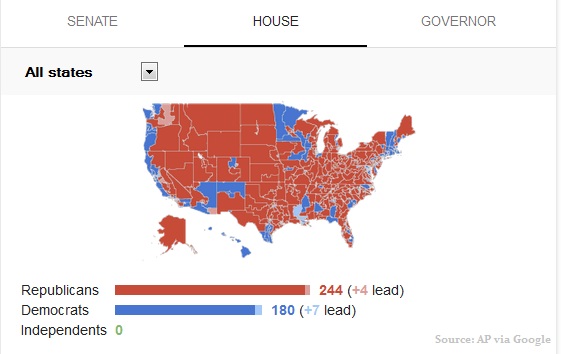
America has just finished another midterm election, and the results were overwhelmingly in the Republicans’ favor. The GOP picked up a majority in the Senate and strengthened its majority in the House, holding more seats there than they have since 1928 with 248. Republicans were also given a great deal of control in state legislatures and governor’s offices.

This map shows just how dominating the Republican performance was, particularly in the House of Representatives.
This, predictably, has led to fretfulness in liberals. Many are reading the huge Republican victory as a rejection of the policies of President Obama. That’s certainly a big element. But what the election results really signify is a population that is utterly confused and desperate for a solution. Public approval for elected representatives and the way the country is moving remain at dismal lows, so it’s not hard to imagine that any change must be for the better. Republican victories are as much a reflection of the left’s disillusionment as they are of the right’s continued mobilization. Continue reading
Texas voter ID requirement is a law demanding to be broken
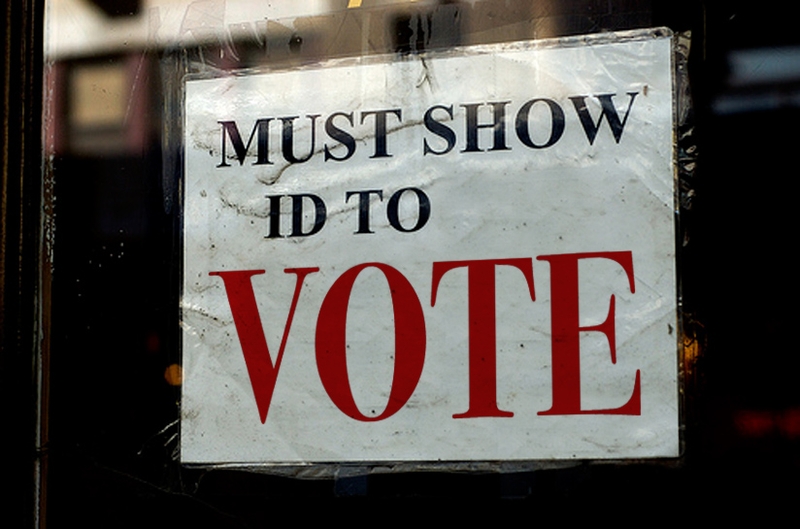
On November 4, millions of Americans will take to the polls for midterm elections. They will not be joined by hundreds of thousands of voters who have been disenfranchised by restrictive polling requirements. Many states have introduced legislation that makes voting more difficult for poor and minority citizens, but in Texas the situation is perhaps most restrictive, most corrupt and most dire. Continue reading
Why the “jobs” argument against climate action makes no sense
In September, hundreds of thousands of climate activists marched on Manhattan to bring attention to – and demand action from leaders on – environmental degradation and climate change. By now, just about everyone recognizes these as civilization-threatening problems requiring our attention. Even the Republican position on the issue is slowly evolving. As the overwhelming evidence implicating human activity mounts and the disastrous consequences of climate change are being experienced firsthand around the world, the question is finally turning from, “Is it happening?” to, “What are we going to do about it?”
Yet there are still plenty of holdouts in the political and business sectors who are stalling environmental progress. One of their favorite canards, and probably the single-silliest argument that can be made against environmental action, is that it will cost America jobs. Continue reading