Condemn the attacks on Charlie Hebdo, but remember that satire should always punch up

Hundreds of thousands marched at unity rallies in and around Paris to show support for free expression in the wake of the murders at Charlie Hebdo.

Hundreds of thousands marched at unity rallies in and around Paris to show support for free expression in the wake of the murders at Charlie Hebdo.

It’s hard to find much room for cynicism in the outpourings of solidarity, sympathy and defense of free expression that have emerged following the slaughter of 12 innocent people at the offices of the French satirical magazine, Charlie Hebdo. The crime committed there in the name of religious extremism is one of the most heinous and intolerable anyone can imagine. Nonetheless, there’s an important element to the story that’s missing from most of the discussion, and it has to do with the power dynamic of cultures and the messaging of satire. Continue reading

State violence, not peaceful protesting, inspires citizen violence

NYPD officers turn their backs on a video of New York Mayor Bill de Blasio at the memorial service for slain officer Rafael Ramos.

NYPD officers turn their backs on a video of New York Mayor Bill de Blasio at the memorial service for slain officer Rafael Ramos.

In times of tragedy, the first question the media asks is, “Who is to blame?” It’s a perfectly reasonable thing to investigate, but certain familiar patterns develop. In cases of serial killers, there’s usually an investigation into the killer’s background, interviews with family members, and so on. When the government is under investigation, there’s a long process of buck-passing that the media dutifully follows like a cat entranced by a laser. And in the case of political murders, blame is usually placed on the opposition party.

Since police militarization became a recurrent topic for mass media, there have been a handful of citizen-on-police killings and assaults, most notably the murder of NYPD officers Wenjian Liu and Rafael Ramos by Ismaaiyl Brinsley. And though virtually everyone has condemned the murders, they’ve nonetheless found their way to becoming a contentious political issue. The divisions, though approximately right/left, are perhaps more accurately defined as authoritarian/anti-authoritarian. Continue reading

Special New Year’s edition: Three 2015 resolutions for America

Say what you will about America, there’s one thing that’s undeniably true: people don’t like you to say what you will about America. Despite being the most powerful economic and military force on the globe for the last 100 years, our culture is quick to take offense at even the mildest of criticisms. Self-reflection has never been our greatest strength, making a list like this controversial.

Nonetheless, we face several crises together. Most commentators don’t consider 2014 to have been a “good news” year. Whether we realize it or want to admit it, this country’s business and political classes have committed inhuman crimes in our name, and they will continue to do so for as long as we let them. If, instead, Americans pledged to confront these issues openly and honestly, we could pave the way to a much brighter future. These are the issues activists, organizers, and opinion leaders should be hammering home in 2015. Continue reading

Sony did the right thing by pulling “The Interview”

You could be forgiven for mistaking the spectacle surrounding Seth Rogen and James Franco’s “The Interview,” a film about an American talk show host who is recruited by the CIA to assassinate North Korean dictator Kim Jong-un, as a convoluted marketing ploy. The real-world story is almost surely a thousand times more interesting than the movie itself, with alleged North Korean cyberterrorists hacking Sony and threatening movie theaters, Sony canceling the film’s Christmas release and President Obama promising to “respond proportionately,” presumably by disrupting some future North Korean film he doesn’t like.

jong-un

“Supreme Leader” Kim Jong-un, center, is the Justin Bieber of North Korea. Photo by Reuters.

There’s a great deal of doubt over whether North Korea is actually behind the hacks, and even greater doubt they could actually make good on any threats. Still, I disagree with Sony’s critics. As difficult as it is for me to say, Sony did the right thing by pulling the movie. Continue reading

CIA torture relevations are unsurprising, but should be prosecuted

Shortly after World War II, the well-known psychologist Carl Jung ascribed a collective guilt to Germans for the crimes of the Nazi Party, Kollektivschuld. Whether Germans realized it or not, the horrors carried out in their borders, by their leaders, and with their tacit blessing would come to bear on their national psyche. To reinforce this feeling of Kollektivschuld, the U.S. and the UK hit Germany with propaganda posters following the war, depicting images of the Holocaust and sternly reminding the German people, “These atrocities: you are to blame!”
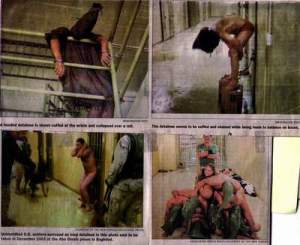
A series of photographs reveal torture and humiliation at Abu Ghraib.

A series of photographs reveal torture and humiliation at Abu Ghraib.

So at what point must we, the people of the U.S., acknowledge our own Kollektivschuld for the crimes of our leaders? Few crimes in world history, let alone U.S. history, compare to the Holocaust, but there is still plenty to reckon with that we have yet to maturely confront: the genocide of American Indians, the enslavement of Africans, a system of racism and violence against blacks that continues to the present, the use of napalm in Vietnam, the dropping of two atomic bombs on Japan, support of brutal dictators and the overthrow of democratically elected governments, the war and sanctions in Iraq that killed perhaps a million or more people – and that’s just what springs to mind off the cuff. Continue reading

The police are a domestic army and we are the insurgents

When dealing with a police officer, there’s a standard wisecrack a lot of people like to pull out: “Hey, I pay your salary; you work for me.” And while it’s true that tax dollars fund America’s police-industrial complex, what’s not true is that police are accountable to the public as an employee is to an employer. Authority figures tell Americans what to do – not the other way around. Continue reading

Ongoing state violence, oppression and injustice provoked Ferguson riots

I’d love to know what Darren Wilson, the white police officer who killed an unarmed black teenager, thinks of the rioting, looting, gunfire, and tense protestor/police standoffs that erupted in Ferguson when a grand jury, well after dark on Monday evening, announced its decision not to indict him. Based on Wilson’s testimony to the grand jury and the story he and his department have told ever since Wilson put six bullets in Michael Brown back in August, he might feel like none of this is his fault. Continue reading

The holiday season is America’s cultural low point

Black Friday is just around the corner, and with it will come the beginning of America’s annual cultural low point: the holiday season. This isn’t about being a Grinch – peace, love and giving are all fine ideas to base a time of celebration around. It’s just that these themes of the holiday season only really show up on greeting cards and television specials; they aren’t what the holidays, in practice, end up being about. Continue reading

GOP backlash to Denton fracking ban reveals a dark hypocrisy

Amid last week’s Republican sweep of the 2014 midterm elections, there were some notable progressive victories. Marijuana decriminalization, gun control laws and minimum wage increases all passed on various states’ ballots. But perhaps the most inspiring initiative voters put into law was a ban on fracking in Denton, Texas. Unfortunately, Texas politicians, bureaucrats and business interests are pledging to fight, repeal and/or ignore it. Continue reading

The 2014 election was a big hustle, and it proved voting is not enough

America has just finished another midterm election, and the results were overwhelmingly in the Republicans’ favor. The GOP picked up a majority in the Senate and strengthened its majority in the House, holding more seats there than they have since 1928 with 248. Republicans were also given a great deal of control in state legislatures and governor’s offices.

This map shows just how dominating the Republican performance was, particularly in the House of Representatives.

This map shows just how dominating the Republican performance was, particularly in the House of Representatives.

This, predictably, has led to fretfulness in liberals. Many are reading the huge Republican victory as a rejection of the policies of President Obama. That’s certainly a big element. But what the election results really signify is a population that is utterly confused and desperate for a solution. Public approval for elected representatives and the way the country is moving remain at dismal lows, so it’s not hard to imagine that any change must be for the better. Republican victories are as much a reflection of the left’s disillusionment as they are of the right’s continued mobilization. Continue reading