Let animals make the case against Kendall Jones’s twisted “conservation”

Who’d have thunk it – the trouble with Africa’s big mammals isn’t trophy hunting, climate change or habitat loss; it’s that they just aren’t being killed properly.

That’s effectively what Kendall Jones, a red-blooded 19-year-old from Texas, would have you believe. The hunter has seen her name in headlines over the last couple of weeks as photos of her posing next to various dead animals went viral and caused an internet maelstrom.

Pictures of the pure-blonde Jones holding up the heads of dead African animals while she grins like it’s her birthday are profoundly unsettling, and the racial and imperialistic components of the imagery are striking. Her poses are also often oddly sexual, which makes sense from a marketing perspective: she’s supposedly in discussions to have a TV show by next year, and with America’s lust for young girls and violence, she will probably get it.

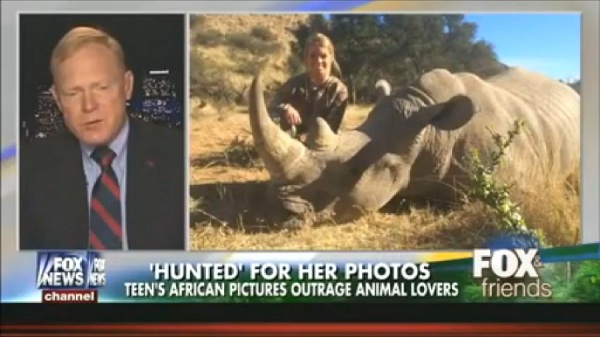
This man is actually saying, at the exact moment this picture is displayed, that hunting "places value on the animals."

This man is actually saying, without irony and at the exact moment this picture is displayed, that hunting “places value on the animals.”

Her Facebook page contains infographics and data extolling the virtues of hunting, all unsourced or sourced to pro-hunting magazines and lobbies. She claims hunting is simply misunderstood, repeating the common trope among hunters that it is actually they who are leading the world’s conservation efforts.

It’s not as though there’s no truth there. Hunting licenses and fees help pay to keep land free from private development. In some cases, hunters target members of a species that have become burdensome or dangerous to the population. Several months ago, just such an endangered black rhino’s life was auctioned off at $350,000. The rationale held that a post-reproductive male is a threat to viable bulls, and if there’s a bloodthirsty millionaire who wants to blow the rhino away, his money can be used for real conservation.

jones

Kendall Jones in her native habitat. When not cheering for the home team, wouldja believe she’s a leading expert on African wildlife? Me neither.

Yet no matter how these hunts are explained, there’s a reflexive revulsion to hearing about them. We’re not talking about hacking away overgrown vines or using dynamite to clear out rocks from a landslide – we’re talking about taking the life of a full-blown, flesh-and-blood, thinking and feeling mammal. Every creature Kendall Jones poses with, beaming her proud Texas smile next to its rolled-back eyes, lived a life she could not begin to comprehend and carried in it a wisdom she will probably never attain.

Jones would probably accuse me of allowing emotion to get in the way of science. She’d be wrong. Science narrows the intelligence gap between humans and the rest of the animal kingdom just about every day. Big mammals are more clever, emotionally sophisticated and complex than we ever dreamed, potentially surpassing humans in some cases. Elephants possess a humbling ability to express deep inner feelings. Whales and primates communicate using a form of language we’re just beginning to understand. Even non-mammals are full of surprises, such as the crow that cracks nuts under a car wheel at a red light or the octopus that escapes from her aquarium to feed on animals in another enclosure.

Despite using the hashtag #ScienceNotEmotion, Jones allows her passion for hunting to interfere with the way she understands the world. Her life’s calling is objectively psychopathic: the killing of sentient beings. In order to justify it, she touts dubious conservation figures, none of which could ever justify the frighteningly incongruous smile she gleams out in pictures with her victims.

On Monday, Jones posted a list of “10 Reasons Why Hunting is Conservation.” About half of the reasons were animal rebound statistics like this one: “In 1900, only 100,000 wild turkeys remained. Thanks to hunters, today there are over 7 million.”

Thanking hunters is odd – surely not even she thinks hunting the animal is what made its population explode. The North American Wild Turkey Management Plan, a pro-hunting group, gives credit for the rebound to “improved habitat management and increased conservation efforts focusing on population status assessment and harvest regulation.” For those who don’t understand the jargon, “harvest regulation” essentially means hunting them less. In other words, hunters, upset that they’d nearly extinguished wild turkeys just as they’d done to the dodo 300 years prior, decided to restrain themselves a little bit to ensure there’d be turkeys to hunt long into the future. So, “Thanks to hunters,” sure – but it’s a little perverse.

An infographic from Jones’s Facebook. This truly remarkable statement credits the rhino’s rebound to the fact that trophy hunters can’t get enough of them, as though that's a good thing.

An infographic from Jones’s Facebook. This truly remarkable statement credits the rhino’s rebound to the fact that trophy hunters can’t get enough of them, as though that’s a good thing.

Boosting a population so that there is more of it to kill is Jones’s idea of conservation. It’s the most vicious form of hypocrisy that exists – announcing yourself as a savior of the thing you’re slaughtering. It’s a bit like Paul Ryan branding himself a champion of the poor in his crusade against welfare, or those “civilizing” missions the U.S. undertook in the Philippines.

If Jones cared half as much about science as she pretends to, she would recognize these animals as having intrinsic worth apart from the market value of their horn or the tourist dollars of a hunt. In cases where an animal is truly going to cause an endangered species more harm than good, removing it should be a sober, solemn affair, not an opportunity to showcase her million-dollar smile to TV producers. Even tribal hunters who depend on their kills for survival display humility and respect.

It’s that despicable tastelessness that’s drawing Jones her flack. Even if hunters are the biggest supporters of true conservation – and that’s obviously highly questionable – her craven glee at murdering so many intelligent, emotional animals is bereft of even the most basic morality and sensitivity. It’s unimpressive on every level – cowardly, sadistic and opportunistic.

Knowing and respecting animals as complex, equal beings with a rich evolutionary history all their own would prohibit a sane person from enjoying their death. The hunting lobby to which Jones belongs sees the entire world as a resource pool for humans, but that’s not the kind of conservation we need. What’s needed is the kind of conservation that values every life as worthwhile, the kind that would only kill as a last resort, and the kind that treats human interference as the problem, not the solution. Only then will these animals regain the freedom to be governed by nature and their own wills.

Supreme Court chooses corporate freedom over personal freedom

On June 30, the Supreme Court handed down one of its most publicized decisions in years. In the case of Sebelius v. Hobby Lobby, the court insisted the “closely held” retail giant was under no obligation to provide its employees with certain kinds of contraception coverage under the Affordable Care Act.

It’s a decision that’s being heralded on the right as an exemplar of constitutional adherence and derided on the left for being yet another barbarically regressive restriction on women’s access to healthcare.

It is much more the latter than it is the former.

Hobby Lobby is owned privately by the Green family, a phenomenally wealthy group of individuals who also claim to be devout Christians. They successfully argued that the portion of Obamacare mandating that an insurance plan cover contraceptives like birth control forced them to counter their religious beliefs.

The Green family may or may not actually be opposed to contraception on religious grounds, but their objection to the contraception mandate is purely an economic one. If they truly felt that contraception was an unconscionable evil, Hobby Lobby would not have $73 million invested in companies that produce it. The religious argument is an obvious smokescreen, meant to conjure up support from Christian conservatives and generate a thin constitutional argument.

gumball

Protester Julia Mitchell holds up a sign as the Hobby Lobby case gets underway at the Supreme Court in March. The overt sexism of a case in which five men determined the fate of birth control for a whole nation’s females has been one of the most controversial aspects of the case. Image via ThinkProgress.

Another of the Supreme Court’s most famous recent decisions was in Citizens United v. FEC, where the court extended first amendment privileges to corporations. In doing so, the Supreme Court, and many of those who support Hobby Lobby’s cause, demonstrated a fundamental misunderstanding of what a corporation is.

Regardless of whether it’s owned by shareholders or by a family – which is, presumably, what the court meant by “closely held,” although the term is probably intentionally vague so as to be applicable whenever a corporation wants to apply it – corporations are not “people” in need of Constitutional protection. They are, essentially, autocratic, private governments. They want the right to treat their employees anyway they see fit and govern their own affairs according to their own constitutions, and the Supreme Court, as well as countless right-wing commentators and legislators, want very dearly to give them that right.

Telling a corporation what to do is one of the greatest cardinal sins in the eyes of the right wing. Most Americans are in no position to negotiate at all, desperate to accept whatever they can for fear of being discarded by the system entirely as government aid is aggressively stripped away.

That arrangement is perfectly acceptable to Republican lawmakers, who have waged an out-and-out war on working Americans for a century. They talk of de-regulation, lowering taxes at the expense of government aid and slashing the minimum wage. Corporate profits and Wall Street earnings are as high as ever, and in many cases, much higher; but they still want more. Sebelius v. Hobby Lobby is just one more case in which “liberty” and “freedom” have been hurriedly granted to the corporate giant requesting it and denied the poor people who really need it.

notachurchMother Jones ran the headline, “In Hobby Lobby Case, the Supreme Court Chooses Religion Over Science.” It’s easy to see what they mean – “birth control” is often associated with rampant, wanton sex, which the Christian right just can’t allow people to get away with. But birth control is actually a vital health need and an extremely useful method for proper family planning. The medical and social demands of birth control are more vital now than ever before, as the nation stagnates in widespread poverty and overflows with unwanted children who parents lack the means to care for and who lawmakers don’t want to help. But the science vs. religion interpretation of the case almost gives the court too much credit – the justices understand fully well that this case is really about the rights of employers to deny their employees benefits.

Another commentator argues that Hobby Lobby’s victory here should obligate them to provide excellent family benefits. If the women working for Hobby Lobby cannot afford birth control and end up with an unwanted pregnancy, will Hobby Lobby grant them leave? America lags woefully behind the rest of the developed world – and much of the underdeveloped world – in this department: parental leave, if granted at all, is often way too short, and working parents struggle with finding the time and the money to take care of their children. But those who are hopeful that Hobby Lobby will make up for the birth control deficit with outstanding family benefits ought not to hold their breath.

The for-profit dream is the formation of an America where corporations enjoy limitless profit, unburdened by the nagging costs of worker benefits, environmentally responsible production and livable wages. These good things have been fought ruthlessly by corporations under the pretense that corporate profit is good for everyone, and the more of it the better. But if corporations lobby extensively against environmental protections, operate massive propaganda campaigns dedicated to convincing Americans that government aid is bad, do everything they can to get out of paying taxes, and are willing to take a fight all the way to the Supreme Court over their intense desire not to spend money on basic healthcare for their workers, how much good is corporate profit really doing for society?

Hobby Lobby’s decision to fight against the contraception coverage mandate of Obamacare just goes to show how very concerned they are that their money not be used for anything that isn’t their own grotesque enrichment. That’s what that “individual spirit” Republicans are always talking about really refers to – people have to knock off this nasty habit they have of pestering employers for things like good wages, benefits, work/life ratio and a decent standard of living and earn those things for themselves.

Clearly, work is no longer the way to a good life. Marx was right to regard the employee-employer relationship as a profoundly antagonistic one. Many Americans “fortunate” enough to have jobs suffer from low wages, grueling hours, cruel bosses and ever-worsening benefits. Yet all we hear, even from commentators on the left, is how important it is to get Americans back to work, and how the way to do that is to make America better for business. With soaring profits and the Congress and Supreme Court on their side, it’s hard to imagine how much better things could really get for big business. The American people are the ones who are desperately in need of a victory right now, and the Hobby Lobby decision is a firm, forceful, sexist slap in the face of every single one of them.

Police violence against innocent family lands 2-year-old in ICU

If the public is starting to sour on the police, there’s a good reason for it: the police soured on the public a long time ago.

Not all police, obviously – like just about any class of people, there are good and bad cops. But as an institution, American police have made so many harmful things common practice that it sounds increasingly naïve to think the good trumps the bad.

Recently, the story of Bounkham “Bou Bou” Phonesavanh – a toddler blown up in May by a SWAT team in Atlanta, just released from the burn unit of an ICU and still struggling with a sensitive prognosis – cast a new spotlight on the horrifying trend of reckless, excessive police force.

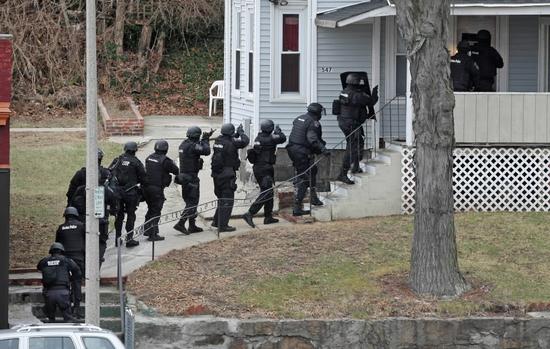
Bou Bou's crib after the flash-bang grenade went off with him in it.

Bou Bou’s crib after the flash-bang grenade went off with him in it.

Truly, the story as recounted by the boy’s mother is one of the most complete, emotional, and grippingly terrifying accounts of the growing epidemic of police violence – just the kind of straight-up, knock-you-in-the-fucking-stomach write-up that’s needed to accomplish what statistics and “neutral” reporting cannot. Her bravery in using the language she does to describe her pain and helplessness is admirable.

There is no defense for the actions of the officers who blew up Bou Bou. They broke into the home to arrest a drug suspect, a relative who was later picked up for simple, small-time marijuana possession. SWAT teams routinely break into homes at night in search of small amounts of drugs, guns drawn and grenades detonating, as though the sleeping pothead inside is wearing battle armor and holding a bazooka.

Until it happens to you – or until someone like Alecia Phonesavanh comes along to write about it so vividly – it all seems remote. But it could happen to anyone. An anonymous tip is enough to send police on a reckless, bloodthirsty hunt into your home, even if it’s not the right address. In Phonesavanh’s case, police found no drugs in the home, nor was the suspect even there. Instead, they put a hole into the chest of a 2-year-old boy sleeping in his crib and ordered his innocent, distraught family to shut up.

Even if the suspect had been home – hell, even if the suspect was home and lording over a $2 million pile of cocaine – their actions are overblown and extremely dangerous. These are grown men with the deadliest weaponry on earth and the moral compass of a high school bully, officially sanctioned to use that weaponry any way they see fit against a population they’re taught to regard as the enemy.

Police officers like to say that excessive force is necessary to protect themselves in the field, because they never know what they’re going to come up against. Their solution to that mystery has been to just assume there’s danger and barge in like terrorists, effectively transferring all of the risk in a police action onto the public, guilty or otherwise.

It’s actually an extraordinary cowardly and harmful thing, but it’s a chance SWAT teams are increasingly willing to take. They create a situation of fear and carnage and then command everybody to remain calm under threat of gunpoint. Many have died in SWAT raids for mistaking police for burglars and drawing a home protection gun on them.

All because his cousin was accused of selling a small amount of marijuana.

All because his cousin was accused of selling a small amount of marijuana.

Because of the easy and widespread proliferation of military-grade equipment throughout America (thanks in large part to organizations like the NRA and weapons manufacturers), police in big cities need to have well-armed and well-trained SWAT teams to deal with the occasional hostage situation or right-wing gunman. But police violence has been used in everything from drug warrants to checking on barbers licenses, and make no mistake about it: even if no shots are fired, kicking down a door and pointing a rifle in someone’s face is an act of obscene violence.

There are those who will doubt Phonesavanh’s story, and it’s easy to see why they might since it sounds so extreme. Sadly, it fits the narrative of forced police entry perfectly – anyone who pays attention to this kind of thing, let alone has been the victim of it, would feel their heart wracked with pain and have no reason to doubt Phonesavanh’s story.

Whether he makes it or not, baby Bou Bou is not collateral damage in a noble war. He is a senseless throwaway of a police culture that cares about arrests and revenue more than protection of the public. The cultured belief shared by the nation’s police force that everyone can be arrested for something and everyone can be treated with violent cruelty has led to police becoming public enemy #1 for many Americans.

The only thing unusual about this image is that it's during the day. Credit: Jane Wingard.

The only thing unusual about this image is that it’s during the day. Credit: Jane Wingard.

Sadly, consequences for officers committing these kinds of atrocities are nearly nil. At the harsh end of the spectrum, they may receive paid leave or a transfer; more often nothing happens at all and they never lose the support of their brothers and sisters in blue. It’s a dangerous kind of nepotism that perpetuates bad feelings between police and the public when, if anyone should be critical of the SWAT team’s actions in Atlanta, it should be other police officers.

If all of this was happening in Turkey, the American intelligentsia would be outraged. Instead, the only mainstream national news story appeared in USA Today announcing Bou Bou’s recovery – happy news, to be sure, but by focusing on it the media can effectively absolve police of any wrongdoing or chalk it all up to an innocent misunderstanding. Meanwhile, politicians and police chiefs offer weak statements like this one from attorney Sally Yates: “Federal and state authorities are coordinating to get to the bottom of what happened.” What happened is obvious – police exploded a hole, deliberately or blindly, into the chest of a sleeping 2-year-old, and under lame pretenses at that. No further investigation is necessary. This kind of political hand washing – looking at both sides, promising investigations, offering condolences – only ensures that nothing ever gets done.

America is not a warzone, no matter how badly police want to turn it into one. The tactics used on mere suspects of minor crimes are only truly warranted by an extremely small percentage of the criminal population. Most people – even drug dealers – are not gun-crazy, suicidal madmen who would endanger their families in a fight with the police.

As mother Alecia Phonesavanh writes, “I used to tell my kids that if they were ever in trouble, they should go to the police for help. Now my kids don’t want to go to sleep at night because they’re afraid the cops will kill them or their family.” Don’t wait for this to happen to you – take action immediately to get the police back on the public’s side. Write letters, confront loved ones on the force, go to the media with any instance of police abuse, keep the cell phone cameras rolling, and rein the police back in as public servants, not public menaces.


About the author: Kyle Schmidlin is a blogger and musician living in Austin, Texas and the founder of Third Rail News.

It’s time to start profiling white men

There’s a reason Elliot Rodger, the shooter and stabber who murdered six people and injured more than a dozen others at UC Santa Barbara over the weekend, thought himself a victim: he was a white man who didn’t get what he wanted.

That’s a crucial characteristic of this story, a more important profile than perhaps any other, and it’s so consistent you could set your watch to it. Lots of people died? Chances are a white man pulled the trigger. Serial killers, polluters, corporate honchos, Republicans – nearly all are white men.

Discussions of white privilege have been cropping up more and more, even in mainstream news, but its existence is still vehemently denied by – who else – white men. Thankfully, Elliot Rodger wrote a 140-page manifesto and posted numerous YouTube videos that leave virtually no doubt about it: because he was a white man, he simply could not deal with a world in which beautiful women weren’t throwing themselves at his feet.

His videos are a truly bizarre artifact. There aren’t many times in history where a murderer leaves such a complete video diary of what drove him to kill. If it weren’t for the fact that he went ahead and did it, you might not take him seriously at all – in one video, he has to interrupt his monologue to get out of the way of a moving car, and in the final video, his “evil laugh” is so unconvincing it deserves a Razzie.

Apart from one parent’s desperate, refreshing plea that someone in charge confront the issue, the killings haven’t resulted in much renewed focus on the gun debate. It’s a shame – Rodger’s firearms were purchased legally, and likely for the sole purpose of this rampage, so if anything, it’s a textbook example of too-easy gun access leading to death and a case where a “good guy with a gun” would have been ineffectual (it took four armed, trained cops to halt Rodger’s drive-by rampage). But mass shootings are such a banality in the U.S. that many of them don’t even get reported on at all, let alone generate rich, status quo-changing dialogue.

Were it not for his manifestos, Rodger’s spree might also have been just another blip in that sordid litany of American bloodbaths. But those sociopathic declarations demand further analysis. They reveal not just an insane person with broken wiring, but someone who’s been inundated in a world where sex is a commodity to be taken by white men at their whim from passive female bodies.

Elliot Rodger takes the “nice guy” angle to an absurd degree. Google “Nice Guys of OKCupid” sometime – it spotlights the ridiculous profiles of men on dating sites who claim to be nice guys, and who claim to be unable to score a mate because of that handicap. It’s not uncommon – and indeed, Rodger’s videos are littered with it – for such a man to express a sentiment like, “These stupid bitch sluts just can’t see how swell I am.” Rodger took that mentality to a horrifying extreme, and different men’s rights activists (MRAs) have been understanding or even, depending on your reading, supportive.

The problem is definitely not Rodger’s inability to get laid. Women – and it’s embarrassing to even have to say this in a country that’s not an Islamic totalitarianism – have as much right to choose their partners as men. And his romantic issues certainly had nothing to do with his being too nice, which should seem obvious enough in hindsight. His problem had to do with his inability to take “no” for an answer. In this proper context, he isn’t the victim of female rejection, but of an immense sexual pressure that begins in high school, continues well into adulthood, and is reinforced by movies, TV, magazines, music and, especially, advertising. The reason he couldn’t take “no” for an answer is because he lived in a society that preaches female availability and parades cartoonish female caricatures on magazine covers and TV shows with the same sensitivity as a can of Coke or a McRib.

"I really just wanted a Coke... oh, OK, I'll take that one on the middle-right, and uh, two of the bottom-left." (Photo taken from a TED talk by Sam Harris)

“I really just wanted Tic Tacs… oh, OK, I’ll take that one on the middle-right, and uh, two of the bottom-left. Does Megan Fox cost extra?” (Photo taken from a TED talk by Sam Harris)

It is true: if women were more available and more submissive, and Elliot Rodger had been able to get one of his own, the killings last weekend would probably not have happened. So that’s one way to fix the problem. Another, healthier option is to stop marketing sex as an entitlement to men, and to stop reinforcing the view that women exist merely as reflections of their man’s status.

Ultimately, that’s what Rodger couldn’t stand, and he all but says it himself: he’s sick of seeing women riding off with other men and he’s sick of his lonely existence, but more so than that he despises the insult to his social status, his masculinity and his perceived good character that rejection made him feel. Chances are Rodger had occasion to turn down several girls in his lifetime, even if he didn’t know he was doing it. Yet you don’t see conventionally unattractive women engaging in shooting rampages because of the way society rejects them. Whether their motives are personal or political, you only see white men doing that, because they just can’t take “no” for an answer.

There is no injustice, nor even inconvenience, that can be done unto white men without their screaming, “Victim!” And they consistently get away with it. Conservative radio is filled with straight-faced laments about the decline of white man’s rule and the encroachment of rogue elements like women and the poor. They’re men with a bottomless bowl of soup whose righteous indignation is strongest when they’re raging over the desperate masses trying to lap up a little bit of what’s spilled over. Even in the wake of his murdering six people, much media focus has been pinned on the completely innocent woman who spurned Rodger as though she ought to share in the blame. If that doesn’t spell out the absoluteness of white male privilege, it’s hard to know what would.

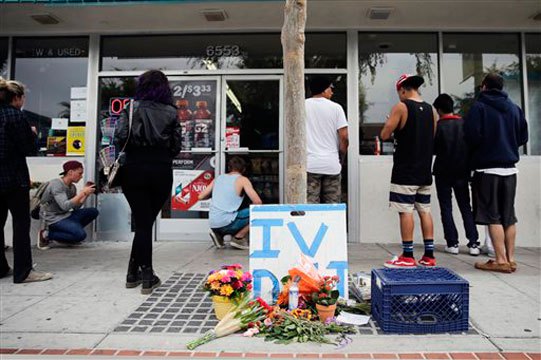
Spectators and mourners gather at one of Rodger's murder sites.

Spectators and mourners gather at one of Rodger’s murder sites.

Elliot Rodger fits the profile of the mass murderer to a tee. Were he and his mass-murdering kin anything other than white men, there’d be serious discussions on the poorness of white male culture, white men’s absence of strong role models, and so on. The struggle to keep these kinds of mass killings from happening in the future has to be waged on multiple fronts, including reformation of gun laws. But as with all criminals, it’s important to address what’s going wrong inside these men’s minds, and a critical look at society’s coarse attitudes concerning sex, privilege and masculinity is a good place to start.

In Albuquerque, citizens seek protection from the protectors

If you move through city streets fearful of being assaulted, you better keep one eye on the police – especially if you live in Albuquerque.

Since 2010, police have killed 25 people in New Mexico’s largest city. For every 20 people murdered there, police kill an additional three. Put another way, in Albuquerque, you’re approximately 15 percent as likely to die at the hands of a police officer as you are a common thug or a spurned lover.

Hostility between the Albuquerque Police Department and the citizens has been boiling over for months, and it reached a peak following the release in March of a disturbing video that showed police killing an unarmed, mentally ill homeless man named James Boyd. Mounting protests in the wake of this spate of killings led to a tense confrontation between the city’s government and its population on May 5. Protestors commandeered a meeting at the Albuquerque city hall, calling for a citizen’s arrest of the chief of police and issuing demands.

Media coverage has been limited. Several outlets ran a tedious story with the headline, “What’s Next for Troubled Albuquerque Police?”, as though the real story is the APD’s struggle to move on from their public scrutiny and not the citizens’ outrage over the deaths of their friends and loved ones. “Angry protesters… shout[ed] at council members and caus[ed] such a ruckus that the panel’s president adjourned the meeting,” the story said. Notice that vivid descriptions of the activists’ misbehavior are plentiful, but for police, the language is more reserved and cautious, even as the story describes their lawless executions.

Worse still, the L.A. Times had this to say: “The council had tried to meet Monday, but adjourned early when rowdy protesters took over the meeting – sitting in council members’ chairs and even eating their Girl Scout cookies.” It’s stunning that a news outlet would even mention sitting in chairs and eating Girl Scout cookies when the discussion is supposed to be on deadly, excessive police force.

Albuquerque may be an extreme case of the law spiraling out of control, but it is far from unique. Heart-wrenching statistics about wrong-door raids and petty crimes being met with deadly violence tell a tale the media won’t touch: excessive police force is a systemic problem, not the result of a few bad eggs. It is routine; daily; even hourly. It runs the gamut from the absurd – a whole team of officers detained a female jogger for jaywalking in February – to the outright hideous, as in the cases of James Boyd, Robert Saylor and countless others.

A symbolic casket bearing the names of people killed by APD was carried to police headquarters. Photo by Luke Montavon, The Jackalope.

A symbolic casket bearing the names of people killed by APD was carried to police headquarters. Photo by Luke Montavon, The Jackalope.

Despite this, and even as more and more of the general population awakens to the reality of routine police cruelty, city officials, congressmen, judges and the U.S. President can say nothing critical of law enforcement without paying an enormous political cost. It’s somewhat mysterious why: on paper, there’s almost nothing in America failing as spectacularly as law enforcement.

Even as the crime rate declines, the use of paramilitary tactics by police escalates. No matter how badly they screw up, there are a plethora of defenses for police to choose from, including the standby, “It’s a dangerous job.” Statistically, being a police officer is far from the deadliest job in America, but a certain degree of risk is entailed. Yet it’s precisely for the assumption of that risk that police are held in such high esteem in the first place. By dressing police up like storm troopers and letting them shoot at anyone who might or might not be holding something that might be a weapon, we take nearly all their risk away and assume it ourselves.

As Radley Balko demonstrates in his crucial “Rise of the Warrior Cop,” both the Pentagon and private defense contractors capitalize on departments’ soaring federal funds, inundating them with unneeded weaponry. Thus, you get perverse statistics like this, from Balko’s book: in 2010 in Johnston, RI, population 28,769, the police department received $4.1 million in surplus military gear from the Pentagon, including 30 M-16s, nearly 10 million rounds of ammunition, a “sniper targeting calculator,” 44 bayonets, 12 Humvees and 23 snow blowers. With so many toys and so little crime, it’s no wonder that police use excessive force on every superficial offense, from low-level drug possessions to barbering without a license.

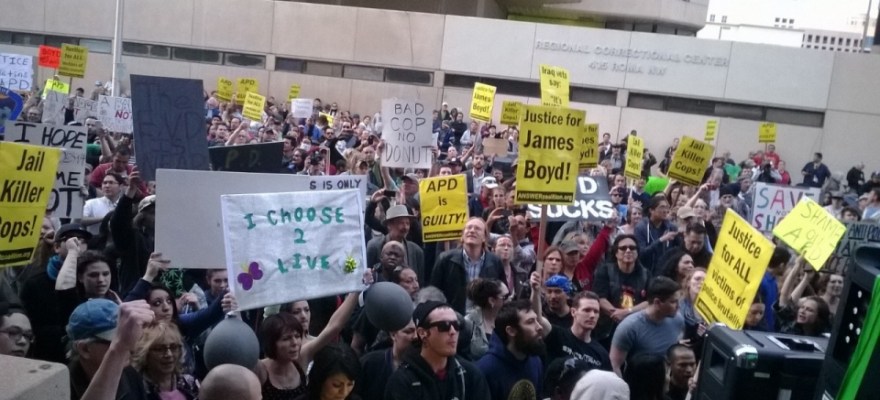
Protesters occupy APD headquarters in March to protest the death of James Boyd.

What’s happening in Albuquerque is truly inspiring. It deserves to be a much bigger news story than it is. As the indictments pour forth on the APD, including a Department of Justice report that documented a pattern of excessive force and poor training, citizens are taking action to ensure that police don’t weasel their way out of the criticism with a few meaningless press conferences and payouts. The city appears to be listening, with Mayor Richard Berry promising changes even before the DOJ issues its recommendations.

Police departments across the nation are rampant with guns and tanks and narrow on compassion and empathy. It’s time to overhaul their militarization and warrior mentality. Law enforcement should be an ally to the people, not the people’s most feared adversary. If change can happen in Albuquerque, it can happen anywhere – we just have to have the courage to demand it.

The Donald Sterling case highlights a shameful hypocrisy

No one can talk about LA Clippers owner Donald Sterling without getting a foul taste in their mouth. The man exudes all the qualities that have derailed civilized society; he is a bitter, bigoted billionaire who feels entitled to anything and everything.

It’s certainly one of the most bizarre cases of public foot-in-mouth that I know of. What it essentially boils down to is a rich, white man arguing with his half-black girlfriend – a transparent gold digger who pretends to wish she could agree with him – about her, in his view, improper decision to post pictures of herself commiserating with black men on social media. In the course of the argument, he outs himself as incredibly racist, saying such surreal things as, “You’re supposed to be a delicate, white girl,” and talking about all the generous gifts he showers his black athletes with.

The whole exchange is a fascinating lens into the wild world of America’s privileged. Imagine stepping behind the scenes of Rome around the time of its collapse, with all the decadence, debauchery and immorality that accompanies it. Sterling regards Stiviano as a status symbol, which is why he’s so offended that she posts pictures online that he thinks cast him in a bad light.

But there’s still something fishy about the reaction to his vile comments. Not in the disgust that just about everyone has expressed, which is understandable, but in the official reactions.

The NBA owners club is a private enterprise, with rules and stipulations that are privately administered. Sterling isn’t in any legal trouble. Yet many people are still worried about his being punished for something he said in private. If legal action were being brought, it’d be tantamount to convicting Sterling of thoughtcrime.

In most cases, I’d be inclined to agree. But Sterling’s case is exceptional. He’s one of the most open racists the media has had the chance to enjoy in recent years; perhaps only Michael Richards generated more heat in the last decade and I’d argue his comments – though far more violent – were actually more innocent, given circumstances and setting. It sends a chill down the spine to know that “owner” is the relationship Sterling has to his mostly-minority basketball team. Knowing what we now know about him, banning him from the NBA ought to be almost a given.

What makes the decision fishy, though, is the NBA’s suddenly giving a shit. As has been consistently pointed out, Sterling’s record of racism extends much further into his past than the incident with girlfriend V. Stiviano. It’s essentially a badly guarded NBA secret, and numerous news outlets have pointed out his official record of discriminating against minorities in his real estate enterprise. Yet now that it’s out in the open, his former friends – who surely knew all along – must vote to remove him from his position.

One must ask whether that’s truly an honorable thing. If these people had no problem with Sterling’s views and, more importantly, his actions when they were slightly less public, why do they have such an issue with them now? It’s damage control, plain and simple: it’s got nothing to do with correcting Sterling’s sins or the NBA ownership evolving on an important moral issue.

Sterling’s own candid comments reveal the staunch racism embedded in the culture of the white, wealthy, ownership class. The whole reason he launched his tirade against Stiviano at all is that his friends were taunting him for her posting pictures with various black athletes. Sterling’s friends said, in essence, “Ha, ha, Don, we saw your girlfriend with Magic Johnson. Do you think she’s fucking him? You know what they say about black penises!” Sterling takes this up with Stiviano, asking, “Why do you have to take pictures with those people and embarrass me like that?” Once those comments are made public, the same type of people harassing Sterling in the first place, leading him to his incoherent, outraged babbling, are now saying, “We are shocked and offended at Don’s comments and want him out of the NBA.” It’s the very definition of hypocrisy, and yet athletes and commentators alike are applauding it.

This is certainly not an attempt to cast Sterling as some kind of victim, as a handful of fringe commentators on the right have. He absolutely deserves all that is coming to him. This article isn’t to argue with that: it’s to say he probably deserves far more, and there are probably far more people out there who do, as well.

I am rarely impressed by the apologies of public figures, nor by reprimands that the wealthy institute among themselves. The league wants to fine Sterling a meager $2.5 million and force him to sell a team that’s worth many times more than that? The poor guy; that really ought to learn him.

America’s billionaires are impervious. Slapping them on the wrist for saying something naughty is totally ineffectual in terms of combating the systemic roots of their incredible, kingly privilege. Donald Sterling is little different from the oil executive who receives a huge severance for wiping out an ecosystem or the banker who gets a bailout when his predatory lending schemes lead to his bankruptcy.

Bundy ranch case about politics, not principle

Chances are you’ve heard, by now, of the great American frontiersman Cliven Bundy, whose decision to parade his inherited cattle on public land that belongs to the endangered desert tortoise has led to his being fined by the U.S. government. Bundy has refused to pay his fees and fines with armed resistance. As a result, there was a standoff in Nevada between the government, who attempted to remedy the debt by seizing Bundy’s cattle, and Bundy’s militiamen.

He definitely isn’t a hero, as some on the right have made him out to be; he’s merely an entitled curmudgeon who doesn’t like to pay bills. The only reason Bundy is a hero on the right is that his adversary is a federal entity, the Bureau of Land Management (BLM), operating under an Obama-controlled White House. The government has been attempting to collect fees from Bundy for 20 years – killing an endangered species is OK as long as you pay for it – but the situation has been in jeopardy of exploding in recent weeks.

Protesters gather at the Bureau of Land Management's base camp near Bunkerville, Nevada

Between fracking and widespread deforestation, the way private entities pillage public land for profit is a tragic disgrace. Bundy wants his freedom to participate, too, and conservatives have rallied in his defense.

As evidence that Bundy’s life as a cause célèbre for the right is based entirely on politics and not on principle, recent racist comments of Bundy’s have caused many of his supporters to walk back their endorsement. Whether he’s a racist or not has nothing to do with whether he’s right or wrong to use federal land in the way he has been – which is, apparently, freely and recklessly.

This is why, despite his multitudinous and colossal douche baggery, I find a very, very small measure of support for Bundy’s cause. His disregard of an endangered species is by far his biggest crime, but good luck selling the idea that a tortoise is more important than a hamburger. Nonetheless, there are questions about the way the government regulates both public and private land, and the Bundy case brings them to light.

Americans who choose to live their life in nontraditional ways face serious and disastrous consequences. Stories break fairly routinely about people in America being punished for living off the land or off the grid. Circumstances vary from story to story – one recent incident saw a renaissance woman being punished for using the sewer system for free – but taken as a whole, the stories paint a compelling portrait of an America that does not tolerate its citizens opting out of the established corrupt, corporate-driven society.

Bundy’s case is very sad for this reason as much as any other. By the right’s making a martyr of such an unsympathetic “victim,” there is a darker outlook on others who might, unlike Bundy, live outside business and the government’s jurisdiction in reasonable, eco-friendly ways. Under the draconian and radical-right direction of the present U.S. government, it isn’t difficult to imagine, for instance, a day when bicyclists will be fined for not pumping gas.

Bundy supporters confront the BLM agents.

Bundy supporters confront the BLM agents.

I also think it’s not so straightforward to criticize Bundy’s militia for showing up with guns. In a recent piece for Salon, Eric Stern writes, “Many repossession and foreclosure actions often involve a sheriff or other armed officials, and confiscation of property is an ordinary means by which a government resolves a debt.” Stern seems to wave his hand at this, saying it’s par for the course and therefore Bundy has no right to resist it.

Yet many folks, including many with the support of their communities and/or the Occupy movement, have protected their homes from bank foreclosures with a collective body mass. That, I think, is a tremendously wonderful and noble thing. Bundy’s wrongness doesn’t stem from his decision to meet an asset seizure with resistance – even armed resistance – but rather his dubious motivation, i.e., his desire to continue pillaging public land without consequence. That’s an important distinction, and to fail to make it is to leave others who resist asset seizure for better reasons open to the same criticism.

Bundy has not been done an injustice by the U.S. government. His reaction to this simple act of bureaucratic enforcement is dangerous and extreme. But the way the story is being presented is just as harmful because of the presupposed universality. It isn’t always wrong to resist asset seizure, nor is it always wrong to call bullshit on certain government fees. It just so happens that Bundy is wrong.

Bundy-ranch

My guess is that cooler heads will eventually prevail. Some lawyer or bureaucrat will talk Bundy down, the BLM will reduce or waive the fee with certain conditions, and the situation may be declared a victory for democracy and the Tea Party. That’s the only reason it might not work – the government-business complex is never too pleased with successful democratic coercion. But in many perverse ways, that is exactly what it will be.

If not, there’s no telling what could happen. It’s a hostile situation, and it’s made all the more combustible by the careless waving around of deadly weapons on both sides. Hopefully, the situation resolves itself peaceably. My only real wish is that this energy could be harnessed for something more productive, like preserving the endangered desert tortoise. Because despite Bundy’s philosophical wrongness, it takes serious energy and popular support of the kind he’s receiving to enact meaningful change. People have just got to choose better causes.